

US Soccer Needs to Start Playing Football: The USMNT should send their stars to Europe

The United States men’s national team failed to qualify for the 2018 World Cup—for the first time since 1986—after losing to Trinidad & Tobago, a team at the bottom of CONCACAF’s final qualifying round standings and essentially playing their reserve squad that day. To qualify, the United States only needed to draw, a feat that was perhaps a bit difficult due to Tobago's waterlogged field. After all, with access to many state-of-the-art stadiums in their home country, the USMNT players were not accustomed to playing on drenched grass. The US team may also have been unlucky, especially after defender Omar Gonzalez inadvertently converted an own goal while attempting to clear the ball, which ricocheted off his shin and looped over goalkeeper Tim Howard.
While some—such as United States Soccer Federation (USSF) President Sunil Gulati—attributed the “ball being two inches wide” to the loss, others argued that this result happened due to a culmination of a failed US Soccer System and the MLS. The most notable critic was former USMNT player and commentator Taylor Twellman, who ranted about how USMNT failed to qualify despite the large pool of resources and money invested into the youth system and MLS. During the rant, Twellman rhetorically asked “what are we doing,” emphasizing that if US Soccer does not change its system, these investments are useless because the national team will always have the same results. Despite this embarrassing incident in US soccer history, the emergence of young American talent in Europe has revitalized hopes that the men’s national team may succeed at the 2022 World Cup.
Soccer is not the most popular sport in America. Many argue that lack of enthusiasm about soccer in the US, compared to Europe and South America, has restricted the United States from becoming a soccer powerhouse.
However, the USSF does have a considerable and growing fanbase and spends a sizable sum of money on infrastructure and player development. Seven percent of Americans say soccer is their favorite sport—compared to nine percent for baseball. The USSF also spends more than 100 million dollars each year, and Americans spend more money on youth soccer than citizens in any other country in the world. Therefore, the problem is not how much we like soccer or how much we spend on soccer. We do not know enough about soccer.
The MLS pales in comparison to European leagues such as the Premier League and La Liga because American teams emphasize physicality over smart, tactical play. In college soccer—which partly serves in developing US soccer players—many coaches solely focus on physicality and fitness and neglect strategic soccer. US Soccer critics have called on the federation to focus on the MLS development academies instead of expensive club soccer programs and the MLS to adopt a more European-style system. Unlike the MLS, European leagues have no salary cap and more lenient restrictions on the number of foreign players.
While the MLS structure and teams’ systems of play contribute to it not being a top league, there is little the league can do due to US geography. Critics often mock the MLS as a “retirement league” because the best talent the league can attract is generally older stars that have retired from European soccer. However, The MLS should take no shame in this label: the prospect of living in the US attracts old European stars, and these players have raised interest in the MLS. Europe will always be the epicenter for the best soccer players in the world. Regardless of the quality of US soccer, top players will not bypass the prospect of playing in the UEFA Champions League or for historic clubs like Chelsea.
As a result, the MLS will never be a development league for the national team’s young stars, but European leagues will. While US soccer has performed decently at World Cups in the past—most notably in 2002 and 2014 with a squad consisting of mostly MLS players—the failure to make the World Cup last year shows that an MLS-based squad is not sustainable. US Soccer needs to transition from having a squad of all MLS players to mostly European stars. At the World Cup, the USMNT competes against the best players in the world, so the players must regularly compete against top talent.
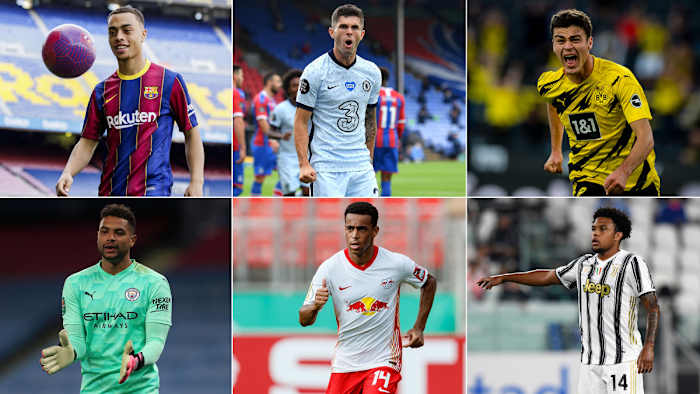
USMNT Greg Berhalter may be starting to understand this concept. During the team’s slate of games in November 2020, the US national team had a roster of players who only play at European clubs. While the federation left out MLS players largely because of the 2020 MLS playoffs at that time, this accomplishment is important in shaping the next World Cup team.
The roster included players that have already succeeded considerably in Europe, including Christian Pulisic—who was the best player on Chelsea last season post-suspension—and Weston Mckennie—who has regularly started this season and has scored two goals and two assists for Juventus. Other young Americans have made spectacular and unprecedented accomplishments such as 21-year-old Tyler Adams—who scored the goal that sent Bundesliga side RB Leipzig to the 2020 UEFA Champions League semi-final—and 19-year-old Matthew Hoppe—who became the first American to score a hattrick in the Bundesliga.
While the USMNT has promising young talent, the team may be too inexperienced to reach the later knockout stages, let alone win the World Cup. The average age of the November USMNT roster was 21 years, and by the time of the 2022 World Cup, most of these young players playing in Europe will be around 21-24 years old. Star soccer players generally reach the peak of their careers around 24-28 years old. As the US has relied on experienced squads in past World Cups, Coach Berhalter may favor less-talented and veteran MLS players over younger European-league players.
The influx of players to Europe and their success in top leagues provide an optimistic future for US soccer, especially for the prospects of contending for a US-hosted 2026 World Cup, where many of these young talents may become established stars.
Soccer and football are interchangeable names for the sport, but the USSF has given these terms distinct figurative meanings. Soccer is what the USMNT plays and what US Soccer has tried to develop, but the USMNT has consistently underperformed. Football is a possessively-oriented and intellectually-based sport, which the best teams at the World Cup play. To contend for the World Cup, the US Soccer must send its players to Europe, so they truly learn how to play the sport. It is time for the USMNT to start playing football.


